Isource Marketing

Is BANT Still Relevant in 2024? Alternative Frameworks

Is BANT Still Relevant in 2024? Alternative Frameworks

Share

No hay newsletters disponibles.

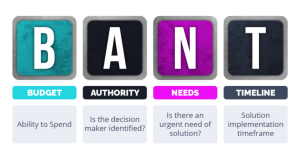
In today’s fast-paced world of business-to-business (B2B) technology sales, the methods we use to find and support potential customers are always changing. BANT, a tried-and-true approach, has long been a key tool. Created by IBM, BANT helps sales teams figure out if a potential customer has the Budget, Authority to make a purchase, a Need for the product, and a suitable Timing. This approach has been essential for sales teams to determine if a prospect is likely to become a customer.

However, it’s crucial to question whether BANT can still meet the demands of the current market. With new tech and changes in the way people buy, looking into new strategies is key to keeping up.
Blog-March-2024_Blog-2-EN-768x408

BANT and the Evolution of Lead Qualification

Checking if someone is likely to make a purchase (lead qualification) is crucial in sales, ensuring our efforts and resources are focused on potential customers who are actually interested. BANT has long served as an easy-to-follow guide for this purpose. However, BANT was created in a time when sellers had more influence over sales. Nowadays, with the internet, buyers do a lot of research and consider various options well before they speak to a salesperson.

This shift means it’s time to rethink old methods like BANT. Sales teams now must navigate a world where buyers are much more informed and have higher expectations. Buyers are looking for products that not only meet their immediate needs but also support their long-term goals.

Alternatives to BANT

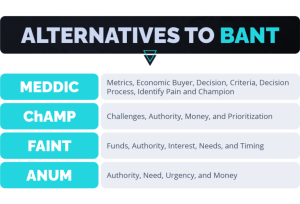
Given that BANT doesn’t fully meet the needs of the modern B2B tech market, new strategies have come up. These new methods are designed to better understand and match today’s buying habits and what the market wants.
Blog-March-2024_Blog-3-EN-768x523

CHAMP

CHAMP stands for understanding the customer’s main CHALLENGES, who has the AUTHORITY to make decisions, how much MONEY they have, and what needs to be done first (PRIORITIZATION). This method focuses more on what the buyer needs than on selling. It helps sales teams make their pitches more relevant by showing how they can solve the buyer’s specific problems.

MEDDIC

MEDDIC is about getting to know the buyer’s business better. It stands for looking at METRICS (or measures of success), finding out who the ECONOMIC BUYER is (the person with the money), understanding the DECISION CRITERIA AND PROCESS, IDENTIFYING the main Pain points, and finding a CHAMPION (someone inside the company who supports your solution). This approach makes sure that sales efforts match up with how the buyer makes decisions and works internally. 

ANUM

ANUM redefines the traditional components of BANT by emphasizing AUTHORITY, NEED, URGENCY, and MONEY, highlighting the importance of the decision-maker’s power and the immediate need for a solution. By focusing on the urgency, ANUM equips sales teams to quickly identify and seize opportunities where prospects are ready to make fast decisions.

FAINT

FAINT, which stands for FUNDS, AUTHORITY, INTEREST, NEED, and TIMING, understands that not every potential customer will have a set budget for your product but could find the means if they see its value. This approach is especially useful in the startup world and innovative industries, where budgets are more adaptable.

Choosing the Right Framework Beyond BANT

Selecting the appropriate framework depends on various factors, including your industry, sales cycle length, and the nature of your product or service. While BANT offers a solid foundation, its alternatives can provide a more flexible and modern approach to understanding and engaging with today’s smart buyers.

When you use these methods in your sales plan, it’s important to find the right balance. You need to make sure the leads are really likely to buy, but also be flexible for each potential customer’s special situation. In addition, you should adapt your CRM (Customer Relationship Management) system to successfully implement the chosen framework and reach your goals.

If you want to learn more about sales and marketing, we recommend you to read: Lead generation: The key to success in sales

In Summary

Although BANT’s straightforward approach and emphasis on critical factors are still appreciated, newer frameworks are proving to be more flexible and thorough, better matching the needs of current buyers.

Adopting these new approaches allows sales teams to improve how they decide which leads to focus on, foster stronger connections with potential clients, and achieve greater success. The quest for improved sales techniques in today’s digital era is continuous, emphasizing the importance of staying updated and adaptable.

At Isource Marketing, we firmly believe that businesses should take the latest trends to make their marketing actions more effective and boost their processes. Please, feel free to contact us for advice or quotes on marketing solutions, and take the bold step to enhance your B2B/B2C strategies with us.
8 Ideas for B2B Lead Generation

8 Ideas for B2B Lead Generation

Share

No hay newsletters disponibles.

2020 was a year to redirect sales strategies. With the arrival of COVID-19 and social isolation, the ability to develop opportunities were restricted and the face-to-face relationship with potential clients became more complex. As a major obstacle, this change represented a new model when prospecting, which will not disappear in the near future.

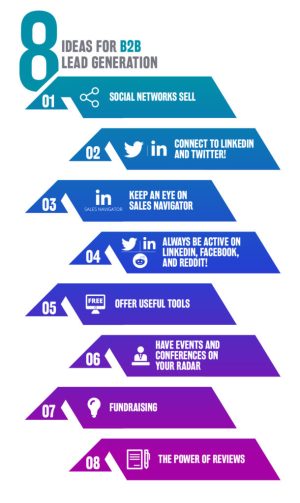
Therefore, in order to help plan a sales strategy, we will be sharing 8 ideas for the successful generation of leads in the B2B sector in 2021.

1. Social Networks Sell
Social selling, with increasing force

Social selling is a way of obtaining prospects with the help of social networks –especially LinkedIn and Twitter– aiming to generate credibility and establish relationships with objective clients and , consequently, achieve commercial objectives. In the so-called “new normal”, social selling is a tool that allows us to take the next evolutionary leap within the digital transformation and adapt to the new sales funnel – depending on customer demand.

2. Connect to LinkedIn and Twitter!
At all times, and at every moment

In addition to the previous point, every day hundreds and thousands of professionals from various industries discuss and communicate on LinkedIn and Twitter. Although both social networks are different and offer different resources, do not lose sight of interactions that take place there; there will always be prospects willing to communicate with you.


3. Keep an eye on Sales Navigator
A premium tool with clear advantages

Do you want to improve your skills to prospect in the B2B sector? Sales Navigator is a premium LinkedIn resource, but is very effective because it simplifies the process of finding, contacting, and staying up-to-date with leads, referrals, and customers. It is a platform that allows you to save hours of manual tracking of potential clients and exchange information with. This will allow you to spend more time closing sales, making calls, or offer products and/or service demonstrations.

graficaEN-610x1024

4. Always be active on LinkedIn, Facebook, and Reddit!
Effective platforms to find potential clients

On them, individuals often ask questions in regards to solving certain problems. They can provide unique opportunities to help find real solutions. In terms of reach, it may not be the main source of attracting prospects, but it does provide a very good opportunity of getting closer to them.

5. Offer useful tools
Free and convenient

They are resources that help strengthen brand recognition and build trust between both parties. For example, if your company develops a collaborative software, providing a free 30-day trial that offers basic functionalities will help potential customers understand and get to know the tool, and decide to purchase the license after the trial period.

6. Have events and conferences on your radar
To connect with potential customers

This way, you will be able to approach your prospects with related topics to the ones seen at these events, in addition to expanding the network of potential clients while attending the event. In many cases, this will require the purchase of tickets. Make sure you analyze whether or not these events are profitable based on the objectives being discussed!

7. Fundraising
An excellent indicator for prospecting

A company that has raised funds is a very good indicator for potential clients to think about. It displays that the organization is booming and may be a smart investment and they are ideal to talk to for two reasons: because they have enough money available to spend or because they need new tools in order to grow.

8. The power of reviews
Focus on competitor’s products

Websites like G2 Marketing SolutionsCapterra and FeaturedCustomers are excellent tools for getting to know your competitors. Not only can you use reviews to understand problems some people are having, but also identify potential prospects who display any dissatisfaction through a review.

We hope this review of lead generation tactics has been helpful. At Isource Marketing we specialize in developing personalized B2B lead generation strategies according to the needs of your business and target market. You can contact us by clicking here, so that together we can take the next step in developing your own desired generation strategy. We can help!

Business Development Manager
Passion: Movies

Is your marketing ROI stagnant? AI is the solution You’ve been looking for

Is your marketing ROI stagnant? AI is the solution You’ve been looking for

Share

No hay newsletters disponibles.

If your marketing team is investing in digital strategies but your return on investment (ROI) isn’t growing at the expected pace, you’re not alone. Many tech companies face this challenge—even with paid campaigns, automation, and optimized content in place.

The reason is simple: traditional marketing is no longer enough. Personalization, real-time responsiveness, and the ability to process large volumes of data are now essential to drive profitability.

This is where artificial intelligence (AI) comes into play. In this blog, we’ll explore how AI is boosting marketing ROI, the key trends shaping the future, and the steps you can take to implement it effectively in your strategy.

Artificial Intelligence in Marketing: The Key to Higher ROI

Artificial intelligence in digital marketing is transforming how tech companies design, execute, and optimize their strategies. With its ability to automate workflows, analyze data in real time, and personalize every customer touchpoint, AI has become a critical ally for driving acquisition, conversion, and long-term loyalty.

By 2025, AI’s impact is no longer a futuristic projection—it’s a measurable and proven reality. This is backed by HubSpot’s recent report Is AI Really Driving ROI for Marketing Teams in 2025?, based on a survey of 700 marketing professionals across Latin America and Spain.

The numbers speak for themselves:

Say AI has improved their marketing ROI.

0 %

Report a direct increase in revenue due to AI implementation.

0 %

Have reduced operational costs through more efficient processes.

0 %

Have improved both content quality and team productivity.

0 %

For tech companies and startups, this represents a unique opportunity to accelerate execution and make smarter, data-driven decisions in real time. AI is no longer optional—it’s the new standard for scaling marketing results with intelligence.

How Is AI Impacting Digital Marketing?

Tech companies are leveraging AI across three key areas to boost profitability and optimize their marketing strategies.

1. AI for Automation and Operational Efficiency

AI-driven marketing automation is one of the fastest-growing areas. In fact, 49.2% of marketers already use chatbots and virtual assistants to enhance user experience and accelerate lead conversion.


Many platforms have integrated AI into their CRM systems to streamline processes such as:


  • Automated audience segmentation for more precise targeting.

  • Email and workflow automation to improve conversion rates.

  • Virtual assistants that handle real-time inquiries and qualify prospects.


With tools like HubSpot Content Assistant and ChatSpot, marketing teams can generate SEO-optimized content, manage customer interactions, and launch campaigns—without manual intervention.

2. AI for Predictive Analysis and Campaign Optimization

In 2025, digital advertising is no longer about simply launching ads—it’s about analyzing real-time data to maximize ROI.

47.5% of marketers already use AI to predict customer behavior and adjust their campaigns across platforms like Google Ads, Meta, and LinkedIn.

With solutions like HubSpot Customer Journey Analytics, companies can:

  • Forecast buying trends and tailor their strategies accordingly.

  • Optimize ad spend in real time, maximizing every marketing dollar.

  • Eliminate underperforming audiences to cut campaign costs.

The result? Greater efficiency, higher-quality leads, and stronger conversions.

3. AI-Powered Content Personalization in Digital Marketing

AI-generated content is another major trend gaining traction. 41.3% of marketers are already using AI tools to create tailored content for different audience segments.

But it’s not just about producing more—it’s about creating highly personalized content based on user behavior. With AI, you can:


  • Generate SEO-optimized blog posts to drive organic traffic.

  • Automate personalized ad copy and email sequences.

  • Create AI-powered visual content, cutting down design and production costs.


Platforms like HubSpot AI Content Generator empower marketing teams to deliver high-impact content without sacrificing quality or strategy.

Challenges and Opportunities of AI in Marketing

While AI in marketing is having a positive impact on ROI, many companies still face implementation challenges.

According to HubSpot’s report:

  • 50% of marketers are not leveraging AI’s full potential due to lack of training.

  • 46.2% cite a shortage of technical knowledge as a barrier.

  • 38.3% experience internal resistance to change.


Despite these challenges, the outlook is promising:
80.3% of marketing professionals plan to increase their use of AI in 2025.

So, what’s on the horizon?

  • Real-time conversion optimization

  • Hyper-segmented personalization at scale

  • Advanced automation powered by AI agents


The strategic adoption of these technologies won’t just improve results—it will determine who leads and who gets left behind in the tech-driven market.

Integrating AI into your marketing strategy goes beyond task automation—it’s about delivering measurable, sustainable results. To achieve that, you must focus on tracking impact and optimizing in real time.

Define Your Key Metrics

Start by identifying clear indicators that help evaluate the ROI of your AI-driven initiatives:

  • Conversion rate

  • Customer acquisition cost (CAC)

  • Customer lifetime value (CLTV)

These metrics reveal how effective your personalized and automated campaigns truly are.

Optimize Continuously

AI enables real-time optimization throughout your campaigns:

  • Reallocate budgets toward high-performing channels.

  • Personalize messages based on user behavior and intent.

Enhance segmentation using up-to-date and predictive data.

How to Implement AI in Your Strategy to Drive ROI

Companies Already Seeing Results

Linkedin

Increased conversions with AI-personalized ad campaigns.

Deloitte

Achieved a 74% boost in customer satisfaction.

Amazon

Scaled sales through dynamic recommendations and pricing.

Implementing AI strategically doesn’t have to be complex—with the right tools and a data-driven approach, it’s entirely achievable.

Key Takeaways

AI is no longer just a trend—it’s a strategic tool, unlocking new opportunities to improve marketing ROI.
Teams that implement AI effectively are seeing higher conversion rates, lower operational costs, and highly personalized campaigns. If your ROI is stagnant, now you know how to reignite it through AI. This is the moment to evolve your strategy.

At Isource, as certified HubSpot partners, we help tech companies integrate AI into their marketing with tools that enable faster, smarter, and data-driven decision-making.

Contact us today and discover how to build an AI-powered marketing strategy that maximizes your ROI.